

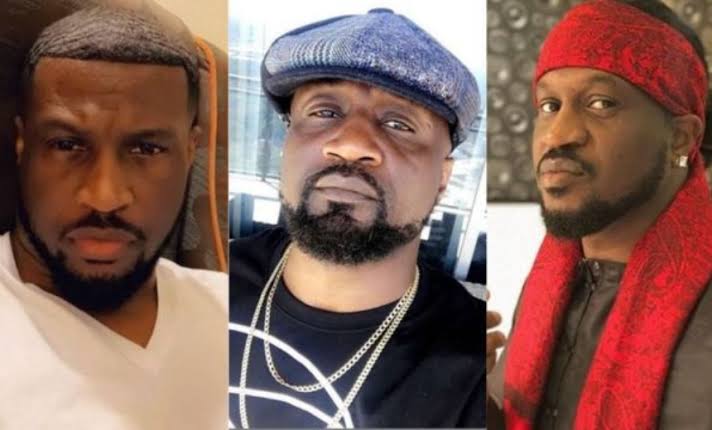
On August 6, 2026, Fire Department Inc., the management company for Paul Okoye, better known as Rudeboy, released a statement. It acknowledged the public conversations surrounding recent events involving the Okoye family. Then it pivoted. Personal and family matters, it said, are best handled with dignity, respect, and responsibility. Rudeboy would not be drawn into an exchange of allegations. The focus remained on the music, specifically the growing success of “Blessed & Alive” featuring Sarkodie, and on the fans who support it.
The statement barely engages the claims circulating about money, management, and the collapse of P-Square. It does not name specific incidents or offer a c rebuttal. Instead it redirects attention toward professionalism, verified information, and the work itself.
The Okoye brothers are no longer simply arguing over what happened. They are competing to define how the story is received.
Peter Okoye, Paul Okoye, and their older brother Jude are discussing the same decade-long conflict. Yet each is constructing a distinct version of it, shaped by a different communication strategy and aimed at a different effect on the public. The dispute that once lived inside the family has become a contest of narratives in which the audience functions as interpreter, juror, and occasional participant.
Mr P’s Strategy of Immersion
Peter Okoye, performing as Mr P, has chosen exposure. In a series of videos that reached part 7 at the time of Rudeboy’s statement, he walks viewers through events in sequence. He names names, describes specific frustrations, and recounts moments of alleged bullying, exclusion, and financial harm. The tone is emotional and personal. He invites the audience into his memories rather than summarizing them from a distance.
This approach treats transparency as the primary currency. By laying out incidents at length, Mr P positions his account as the fullest available record. Listeners are asked to experience the conflict through his perspective, to feel the weight of each decision and the isolation that followed. The format itself—direct-to-camera videos posted serially—creates a sense of ongoing disclosure. Each new installment builds on the last, keeping the audience engrossed in the story.
It generates a particular kind of intimacy. Fans who watch the full sequence emerge with a detailed map of one brother’s experience. That map becomes the reference point against which later statements are measured.
Jude Okoye’s Point-by-Point Defense
Jude Okoye, the older brother and former manager of P-Square, has responded in a more contained and reactive mode. His public comments, including a video explanation of his side, tend to address specific accusations rather than unfold a parallel personal history. The posture is defensive and explanatory. Credibility is the central concern, each reply aims to correct or contextualize claims already in circulation.
Where Mr P expands the narrative outward, Jude works to stabilize it. He answers allegations as they arise, seeking to preserve his own standing by clarifying roles, decisions, and outcomes. Viewers receive counter-details rather than an invitation into lived memory. The effect is to slow the momentum of the more expansive account and to insist that the record is incomplete without his contribution.
This strategy assumes an audience willing to weigh competing facts. It treats the public as a kind of informal tribunal, and leaves less room for emotional identification. The emphasis remains on what can be verified or disputed rather than on how the events felt.

Rudeboy’s Deliberate Distance
Paul Okoye’s management statement represents a third path. Rather than enter the detailed exchange or answer point by point, it steps aside. The language repeatedly returns to music, fans, professionalism, and the request for privacy. It asks supporters and media partners to avoid speculation and to rely on verified information. It frames continued public commentary as a distraction from creative work.
By declining to compete inside the narrative already advanced by his twin, Rudeboy attempts to shift the conversation to a different register. The conflict is acknowledged but not engaged on its own terms. Attention is guided toward ongoing projects and the relationship with audiences across Nigeria, Africa, and beyond. The implication is that the most responsible posture is professional restraint.
The statement’s restraint itself becomes content. In an environment where detailed videos and rebuttals dominate timelines, a refusal to match that intensity registers as a distinct choice. It signals priorities and invites the public to respect boundaries even while the other brothers continue to speak.

When the Audience Joins the Story
Social media has altered the conditions under which family conflicts among public figures unfold. What once remained private or circulated through limited channels now appears in installments that anyone can watch, share, and dissect. Instagram videos, management releases, and subsequent commentary function as primary documents. Fans examine wording, timing, facial expressions, and omissions with the attentiveness once reserved for official records.
Every decision—whether to post a multi-part series, issue a formal statement, or remain largely quiet—shapes perception. Silence is no longer neutral; it generates its own interpretations. A detailed video series creates one set of expectations. A call for dignity and verified information creates another. The public does not merely observe these choices. It evaluates them, argues over them, and in some cases amplifies or challenges them.
The Okoye dispute illustrates how thoroughly the boundary between private disagreement and public performance has eroded. Court proceedings and an EFCC matter form one track of the conflict. Parallel to it runs a continuous stream of content that treats the audience as a secondary arena in which legitimacy is tested.
Celebrity Conflicts as Narrative Contests
The Okoye brothers supply a clear case study of a broader pattern in contemporary celebrity culture. Disputes are no longer confined to legal filings or private negotiations. They are prosecuted through interviews, social media posts, carefully worded statements, and appeals to public sympathy. In some instances, the verdict of collective opinion carries practical weight comparable to formal outcomes.
Each brother’s method reflects an understanding of that reality. One prioritizes exhaustive personal testimony. Another focuses on corrective clarification. The third emphasizes professional distance and creative continuity. Each seeks to influence how the shared history is understood by people who have no direct knowledge of the events but who consume the accounts in real time.
The underlying family and business disagreements remain unresolved. Layered on top of them is a competition over which version of the story gains the most coherent and persuasive shape in public view.
The most striking element of the Okoye saga may not be that three brothers recall the same sequence of events through different lenses. It is that large numbers of listeners and readers are actively deciding which account feels most credible. In an environment where every post and statement functions as evidence, that process of collective judgment has become inseparable from the conflict itself.
Author