

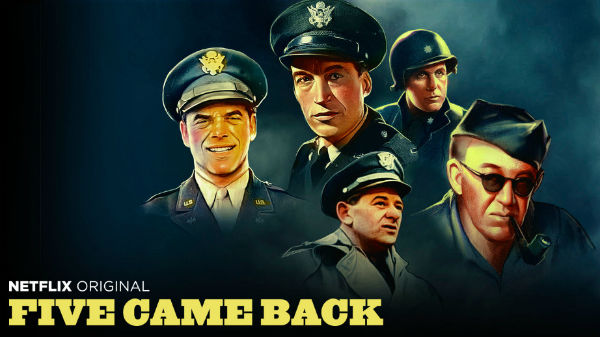
William Wyler lost his hearing, George Stevens never made another comedy, and John Huston suffered what is now known as Post Traumatic Stress Disorder after years of filming scenes of death and destruction.
The three directors, along with Frank Capra and John Ford, were not the only ones changed by their experiences documenting World War Two.
Hollywood itself was also changed, the documentary “Five Came Back” shows, bringing a new realism to way the war was depicted in the movies and its effects on those who served and those who stayed behind.
“The toll the war took on these men was profound,” said Mark Harris, author of “Five Came Back” that was adapted for the documentary.
Their experiences making documentaries and short films “gave them an appetite for independence and autonomy and (made them) strive harder for realism and immediacy in their Hollywood features,” Harris added.
“Five Came Back,” released on Netflix on Friday, tells the stories of the war time directors and adds commentary by modern filmmakers Steven Spielberg, Francis Ford Coppola, Paul Greengrass, Guillermo Del Toro and Lawrence Kasdan.
Although none of the five signed up for combat, all left successful careers and saw action during their years filming many of World War Two’s biggest turning points.
The decision to document the war “came from General George Marshall’s belief that Hollywood filmmakers could grab people’s hearts in a way that newsreel films couldn’t,” said Harris.
Before the United States entered the war, “audiences were very used to a sterilized Hollywood war, with bloodless combat,” Spielberg reflects in the documentary.
Wyler, Capra, Huston, Ford and Stevens, however, captured the grim realities of battle in the North African campaign, at D-Day and the Battle of the Bulge, as well as the liberation of Paris and Rome and the horrors of Dachau.
Returning to Hollywood, the men’s careers took different turns. Wyler’s portrait of mentally and physically disabled veterans in “The Best Years of Our Lives” won seven Oscars in 1947.
Capra made the sentimental “It’s a Wonderful Life” in 1946 which, while now regarded as a classic favorite, was a huge flop and crushed his spirit.
Stevens, a master of musical comedies in the 1930s, created film from the liberation of the Dachau extermination camp that was used at the Nuremberg war crimes trials. He was so shaken by what he had seen that he abandoned comedies and went on to make serious movies like “The Diary of Anne Frank.”
Author